How to Trade Meme Coins With a $10 Bankroll and Still Book Real Profits
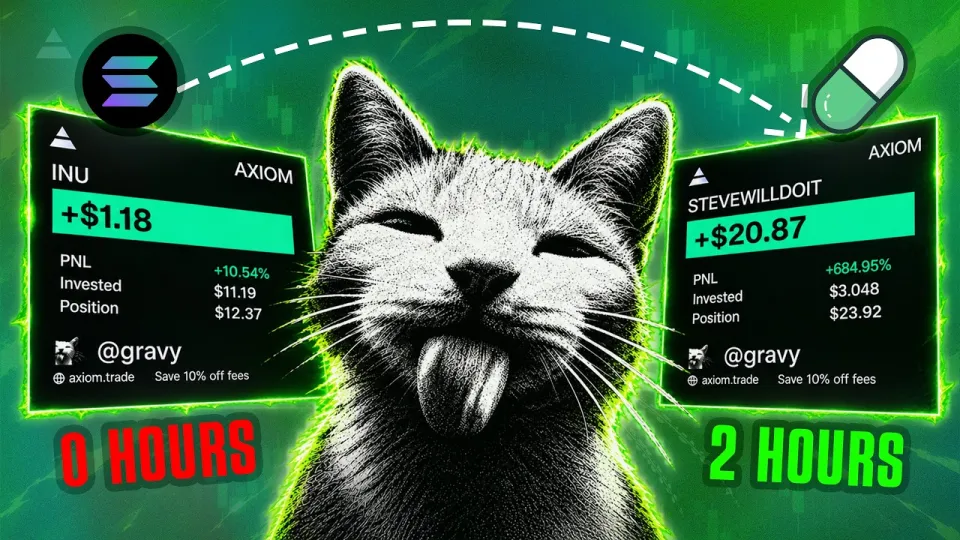
Video: I Tried Trading Memecoins with Just $10
You can order the same kind of articles for your own video to boost it on YouTube and Google. Just message the Telegram bot @sat_sit_bot. The bot writes and publishes the articles itself (with your YouTube video embedded) on popular topical websites (no ads). Try it free: 50 articles on us.
· based on the channel gravy
Meme coin trading with a $10 bankroll is possible, but only if you treat fees and position size as the strategy rather than an afterthought. In a test run on Solana, five trades were placed with every buy kept under 0.05 SOL, and the results came down to narrative timing and exit discipline more than luck. The tooling used for execution was Axiom, where the referral link gives 2x cashback and 15% lower fees, which matters enormously when your whole account is ten dollars.
Why a $10 meme coin portfolio is a fee problem before it is a picking problem
A small bankroll dies from friction, not from bad picks: on Solana every swap carries a base network fee, a priority fee, and a DEX or aggregator cut, and those costs are fixed while your position is tiny. If a round trip costs a few cents each way, a $2 position needs a double-digit percentage gain just to break even, so the first job is compressing costs and the second is sizing up enough per trade to make the move worth the fees.
Three levers do most of the work:
- Use a router with cashback and fee discounts, so part of the fee comes back on every trade.
- Keep each buy large enough in absolute terms (0.03–0.05 SOL) that a 30–50% move pays for the round trip several times over.
- Cap the number of trades per day, because each extra round trip is a fixed tax on a small account.
That is the entire case for trading meme coins with a small portfolio: fewer, better-sized, cheaper trades. Anything else is donating the bankroll to validators.
What the five trades actually looked like
The test ran five positions, all under 0.05 SOL per buy, each chosen for a specific narrative rather than a chart pattern. Tickers were STEVEWILLDOIT, NPC, MET (Meteora), PUMPY the Trader and UNTXD, and the reasoning behind each entry was documented before the outcome was known.
The pattern across the set is consistent with how low-cap Solana launches behave: entries are narrative-driven, exits are quick, and one position is held too long or cut too early. The host of the gravy channel is explicit that one of the five was fumbled hard, which is the more useful data point than the winners, because small-account traders lose money on exits far more often than on entries.
The X Money meta and why those tickers ran
Narratives on Solana are borrowed from whatever crypto Twitter is arguing about that week, and the X Money coin meta is a clean example: it is tied to e/acc talking points and the Cream angle, which gave a cluster of tickers a shared story to trade against. When a meta like this forms, capital rotates between the coins carrying the same narrative, so a ticker with the right name and the right community attention can move 2–5x in hours while a technically identical coin with no story does nothing.
For a $10 account the practical takeaway is that you are trading attention, not fundamentals. The moment the meta stops being discussed, the bid disappears, which is why the exits in the test were fast and why holding a narrative coin after the timeline moves on is the most common way small traders give back gains.
How to size and exit trades when the whole account is ten dollars
Position sizing is the only risk control a $10 account has, so the rules have to be mechanical rather than emotional. A workable structure for meme coin trading at this scale looks like this:
- Split the bankroll into four or five tickets of 0.03–0.05 SOL so a single rug cannot end the experiment.
- Take partial profit at the first 2x on the strongest position, because a small account needs realized gains, not paper ones.
- Cut a position when the narrative thread goes quiet, not when the chart looks scary.
- Never add to a loser: averaging down on a low-cap with no bid is how ten dollars becomes two.
Selling is where most of the money is made or lost. A 20–40% drawdown that later recovers is normal in these coins, and panic-selling into it is exactly how traders end up watching the same ticker run without them. Deciding the exit before the entry removes that decision from the moment of maximum stress.
The questions small-account traders keep asking
The most common doubts around low-balance meme coin trading are about consistency and information overload, and both are real. Finding coins with good narratives means reading a lot of tweets, remembering who actually has influence in a community, and separating a genuine meta from a paid shill, which is exhausting work that does not scale down to a $10 account.
The second recurring complaint is timing: buying a dip and watching everyone else sell, then exiting at a loss only to see the coin run later. That is usually a symptom of buying after the narrative has already been priced in, and the fix is to enter earlier and smaller rather than to chase strength. A third theme is tooling trust, including warnings that some free VPN and privacy apps monetize user data, which is a reminder to keep trading infrastructure boring and reputable. The remaining question, whether $10 is even worth the effort, is answered by the fee math: it is, as a training ground, not as an income.
Useful links
- Axiom trading terminal with referral cashback
- The Trenches Discord: https://discord.gg/W7TqkExcSd
- Free Axiom imports and trade signals Discord: https://discord.gg/9W5j3XUgYB
- Host's X account: https://x.com/gravyski
- Leverage trading with 20% futures fee reduction: https://www.bitbase.com/landing-page/trading-earning-Gra?ref=8CYOGY
What a $10 meme coin experiment proves
A ten-dollar bankroll cannot make anyone rich, but it can prove whether a trader has a process, and the five-trade test on the gravy channel shows the process is mostly cost control plus fast exits. Keeping every buy under 0.05 SOL forces discipline that a larger account would hide, and the single fumbled trade is a better lesson than the winners. Anyone repeating the experiment should start with fee discounts through Axiom registration and cashback, size each position so a 2x is meaningful, and write the exit before the entry. The channel is now asking viewers whether the next step should be a live session from 0.1 SOL or 1 SOL, which is the right question once the mechanics are understood.
Key takeaways
- Five real trades on Solana, each buy kept under 0.05 SOL, were run from a roughly $10 bankroll.
- Tickers covered include STEVEWILLDOIT, NPC, MET (Meteora), PUMPY the Trader and UNTXD.
- The X Money coin meta is tied to e/acc narratives and the Cream angle, which is why those tickers ran.
- Fees are the main killer of small portfolios: Solana priority fees plus Axiom's referral cashback and fee discount change the math.
- The host of the gravy channel fumbled one of the five trades badly, and asks viewers whether to live trade from 0.1 SOL or 1 SOL next.
Source: I Tried Trading Memecoins with Just $10 · Markdown version
Questions & answers
Can you really trade meme coins with only $10?
Yes, but the goal is learning the mechanics rather than earning income. With buys of 0.03–0.05 SOL and fee discounts or cashback on the router, a $10 account can take several positions and still come out ahead on a single 2x. Without cost control, fixed fees eat most of the gains.
How do I stop losing money on exits in low-cap coins?
Decide the exit before you enter and take partial profit at the first strong move. Selling into a 20–40% drawdown is usually the wrong call in these coins, because the same ticker often recovers once the narrative is discussed again.
Why do some meme coins run while similar ones stay flat?
Attention is the asset. Coins tied to an active meta, such as the X Money narrative built around e/acc and Cream talking points, attract rotating capital, while identical coins with no story get no bid.
Is a small portfolio worth the effort compared with just buying SOL?
As a training ground, yes: the fee math forces discipline that larger accounts hide. As a returns strategy, a $10 bankroll is too small to matter, so treat it as paid practice and scale only after the process is consistent.